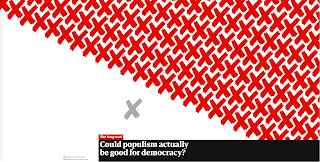
Here is an interesting article Rubin brought to my attention from The Guardian newspaper's series The Long Read. If the 'long' bit puts you off, it's also available as a podcast audio version
Barr, Robert R (2009) 'Populists, Outsiders and Anti-Establishment Politics' in Party Politics 15(1): 29-48 To what extent and in what ways were the following political figures / parties populist in their campaigning, according to Barr’s three dimensions (plus the ‘secondary’ stylistic feature of charismatic leadership)? Dimensions of populism Donald Trump (Republican) when running for president Nigel Farage (UKIP) when campaigning for Brexit Jeremy Corbyn (Labour) in 2017 general election Political outsider Anti-establishment appeals Plebiscitary linkage Charismatic leadership Can Trump continue to be a populist whilst in government? ( Here and here are a couple of articles as food for thought)
Reading: Gurevitch, Michael (1995) ‘The Crisis of Communication for Citizenship: In And Out of the Ashes’ in Blumler and Gurevitch (eds) The Crisis of Public Communication . London: Routledge This week we will examine the watchdog or ‘fourth estate’ role of journalism in more detail, exploring the ways in which political elites have tried to secure favourable media reporting without direct control of the media, and journalists’ responses. The key question is whether this tussle between journalists and politicians ends up serving the public interest (e.g. by informing voters) or not, and therefore whether it is democratically functional. Does this even matter in the contemporary digital media environment? In this week’s reading, Michael Gurevitch notes problems with this model of the press that became apparent when he was writing in the mid-nineties: “This is not to allege that occasions when people, politicians and the press have engaged in ...
Miller, David, and William Dinan (2007) ‘Public Relations and the Subversion of Democracy’ in Miller and Dinan (eds.) Thinker, Faker, Spinner, Spy: Corporate PR and the Assault on Democracy . London: Pluto Press Miller and Dinan outline Grunrig’s four-part model of PR, which acknowledges undemocratic practices, but suggests that PR has moved on to more legitimate approaches: “It distinguishes ‘press agentry’ , which is most commonly identified with promotional media work; ‘public information’ , which uses one-way communication to promote a given message, perhaps in the public interest; the two-way asymmetrical model , in which feedback and perhaps market research and public opinion polling are used to manipulate audiences more effectively; and a two-way symmetrical model which is alleged to help ‘create mutual understanding’ between an organisation and its publics.” (Miller and Dinan 2007: 16) Which of the above categories would you place the followin...
Comments
Post a Comment